Compound vs Recurve Bow: Which One Should You Choose?
When starting archery, one of the first decisions you’ll face is choosing between a recurve bow and a compound bow. Both are powerful, accurate, and widely used — but they are built differently, shoot differently, and serve different purposes.
In this guide, we’ll break down:
✔ how each bow works
✔ key differences
✔ pros & cons
✔ best use cases
✔ which bow is right for you
🏹 What is a Recurve Bow?
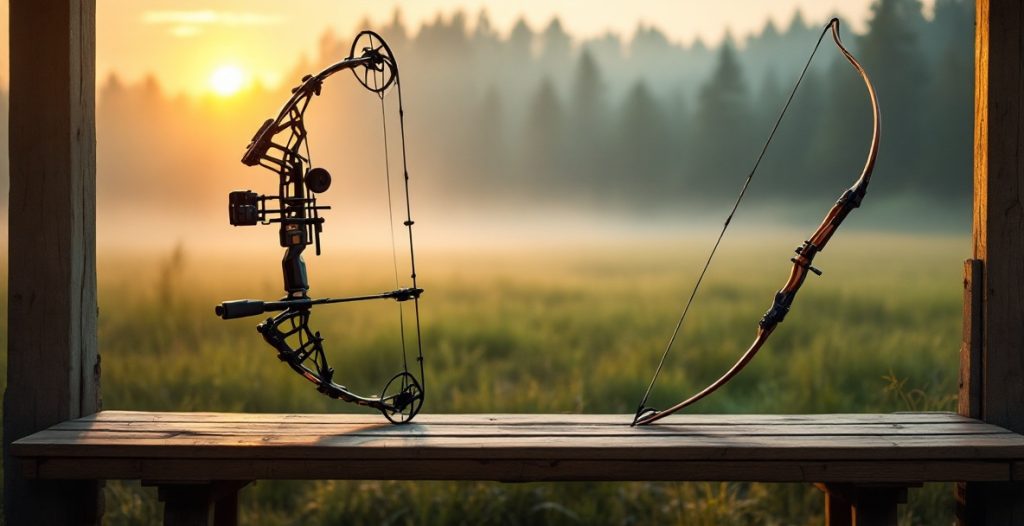
A recurve bow is a traditional style bow recognized by its limbs that curve away from the archer at the tips. This shape stores more energy than a straight-limbed bow, producing more speed.
Key Characteristics
- Simple design (riser + limbs + string)
- No cams or mechanical systems
- Used in the Olympics & target archery
- Can be shot with fingers (tab/glove)
Where Recurves Are Used
Recurve bows are popular in:
✔ Olympic target archery
✔ School & beginner programs
✔ Traditional archery
✔ Field archery
Why People Choose Recurve
- Great for learning fundamentals
- Lightweight and easy to maintain
- Affordable and upgrade-friendly
🏹 What is a Compound Bow?
A compound bow uses cams, cables, and modern engineering to maximize efficiency. When the string is drawn, the cams rotate and reduce holding weight — known as let-off.
Key Characteristics
- Mechanical system (cams, cables)
- Let-off (commonly 70–90%)
- Shorter axle-to-axle length
- Shot with release aid (not fingers)
Where Compounds Are Used
Compound bows are popular in:
✔ Bowhunting
✔ 3D archery
✔ Target archery (non-Olympic)
✔ Competitive field tournaments
Why People Choose Compound
- Higher arrow speeds
- Reduced holding weight at full draw
- More accuracy & stability at long distances
⚙ Mechanical Differences: Recurve vs Compound
| Feature | Recurve Bow | Compound Bow |
|---|---|---|
| Design | Simple limbs + riser | Cams + cables + limbs |
| Let-Off | No let-off | 70–90% let-off |
| Draw Cycle | Smooth & linear | Break-over & valley |
| Accuracy | Form-dependent | Mechanically assisted |
| Tuning | Basic tuning | Complex tuning |
| Maintenance | Simple | Requires knowledge |
If you want a bow that teaches clean form, recurve is ideal. If you want mechanical precision with reduced effort, compound is the better choice.
🎯 Shooting Differences
Recurve Shooting Style
- Drawn and held with finger release
- Requires strong back tension
- Every shot builds technique, coordination & discipline
Compound Shooting Style
- Drawn using mechanical release aid
- Anchoring is consistent due to peep sight
- Easier to hold steady due to let-off
Bottom Line
Recurve shooting demands more discipline & form control, while compound provides more mechanical consistency for accuracy.
🏆 Accuracy Comparison
Many beginners assume a recurve is less accurate — but that’s not fully true.
Recurve Accuracy Depends On:
✔ Form
✔ Release
✔ Anchor point consistency
✔ String alignment
✔ Sight discipline
Compound Accuracy Depends On:
✔ Mechanical let-off
✔ Release aid
✔ Peep + scope alignment
✔ Arrow speed & tuning
Overall:
→ Compound bows are easier for beginners to shoot accurately at longer distances because they minimize human error.
→ Recurves teach foundational accuracy through technique, not technology.
🎯 Speed & Power
Compound bows produce more speed due to:
✔ cam energy storage
✔ higher efficiency
✔ optimized let-off
This makes compounds preferable for:
✔ bowhunting
✔ long-distance 3D shooting
✔ competition formats requiring speed
Recurves have lower speed but smooth, predictable arrow flight ideal for:
✔ Olympic target shooting
✔ beginner training programs
🛠 Maintenance & Tuning
Recurve Maintenance
✔ Simple to maintain
✔ Limbs can be removed easily
✔ String replacement is quick
✔ Tuning mainly involves:
- brace height
- tiller
- nocking point
Compound Maintenance
✔ More complex due to:
- cam timing
- cable tension
- peep alignment
✔ Requires bow press for most adjustments
✔ Highly tunable but needs knowledge
If you enjoy technical tuning, compound is rewarding. If you want simplicity, recurve is better.
💰 Price Comparison
| Cost Category | Recurve | Compound |
|---|---|---|
| Entry Level | ₹5,000 – ₹20,000 | ₹15,000 – ₹50,000 |
| Mid-Level | ₹20,000 – ₹60,000 | ₹50,000 – ₹1,00,000 |
| High-End | ₹60,000+ | ₹1,00,000 – ₹2,50,000+ |
(Note: ranges vary by country/brand)
Recurves offer a cheaper entry point, compounds cost more due to technology & components.
🤔 Which Bow Should You Choose?
Ask yourself these questions:
Q1: What is your goal?
✔ Target archery / Olympic style? → Recurve
✔ 3D / Field / Hunting / Tactical? → Compound
Q2: Do you prefer simplicity or technology?
✔ Simple setup + technique focus? → Recurve
✔ Mechanical precision + easier accuracy? → Compound
Q3: How much maintenance do you prefer?
✔ Low maintenance → Recurve
✔ High tuning possibilities → Compound
📝 Pros & Cons Summary
Recurve Pros
✓ Simple design
✓ Cheaper entry cost
✓ Olympic-approved
✓ Teaches strong fundamentals
Recurve Cons
✗ Requires high form discipline
✗ Less speed & power
✗ More difficult at long range
Compound Pros
✓ Higher arrow speeds
✓ Easier accuracy at long range
✓ Let-off reduces holding weight
✓ Tunable & customizable
Compound Cons
✗ Higher cost
✗ Complex tuning & repairs
✗ Not used in Olympic archery
🏁 Conclusion
Both bows are excellent — but built for different experiences.
Choose a recurve if you want:
✔ traditional shooting experience
✔ Olympic-style target archery
✔ technique-based skill development
Choose a compound if you want:
✔ mechanical accuracy & stability
✔ long-distance precision
✔ bowhunting or 3D archery
Ultimately, the best choice depends on your goals, budget, and shooting style.